Newport Tales – Part VIII

Richard Bach’s Jonathan Livingston Seagull is an allegory and bestseller from 1970. There are a lot of truths in the book about doing things well and not being afraid to be different. Jack, one of our owners, considered it the philosophy on which KSND was built. He purchased copies for all original staff members and made it required reading prior to our sign-on.

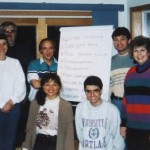
I still have my copy of the book, including his inscription: Clarke, thanks for being part of our team at KSND. — J.L.S. The fable meant a lot to Jack, and it was interesting that his initials were the same as the protagonist’s. The night before sign-on we all met at Jack’s house in Depoe Bay to discuss how KSND would soar above all other stations and leave its mark on the Central Oregon Coast.

KSND had CD-quality sound. We honored the music by making it the focus of the station in two distinct ways. We didn’t talk over the beginnings of songs, and we didn’t over process the audio. These were cardinal rules.

Frankly, we didn’t talk just to hear ourselves speak when the microphone was open, either. We had a number of on-air promos running with crazy radio deejay characters yakking about all sorts of nonsense when suddenly Charlie Tuna came on over the din and reminded listeners that at KSND they heard, “all the hits without all the (MOOOOOOO sound effect)…bull,” and then into another song we went! The station even had a little inflatable bull, Buddy, that sat on the counter of the drive-up prize window — a humorous reminder that we were serious about limiting the BS.

The audio processing was a big deal for Jack and Keith, too. All audio needs to be processed before it goes on the air, as it helps keep sound levels from getting too high or too low. Unfortunately, most radio stations long ago adopted the practice of processing much heavier than necessary as a way of sounding louder. The by-product is distortion as the music loses its dynamics.

We ran an on-air promo comparing over processing to running music through a trash compactor. A simple way to explain the practice is that the high end and low end dynamics of the music are crushed, or compressed, into one level. The more the processing is cranked up, the worse the compression and audio artifacts become. This is a great website that describes basic audio processing for the lay person. It’s worth visiting just to hear the examples made using Counting Crows’ Big Yellow Taxi. Keith liked to point out that listeners had a volume knob on their radios if they wanted the music louder, but they didn’t have distortion knobs to fix the bad compression.

KSND was built to stand out from the rest of the market. Our owners were audiophiles who perfected their approach in past broadcasting jobs. The play on our call letters was K-Sound (not K-Sand!) During our evening meeting we discussed persevering to be the best, pushing beyond our perceived limits, and overcoming limited thinking. Sounds like the seagull, doesn’t it? Jack said the market couldn’t support another station. Years of research in Newport and the Lincoln County listening market had shown that KSND could make it, but another station would inevitably go out of business once we gained a foothold.

We were all excited about the launch and thrilled to be part of a very good team that was about to give the market a jolt. I mentioned to the staff that when I was looking for my first job out of college a year before, I contacted the program director at what was now going to be our direct competitor. He told me someone would have to get hit by a milk truck before there would be a job opening for me. I chuckled at our meeting that the milk truck was here…and KSND was driving it. Sweet revenge!

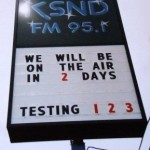
The meeting ended with a screening of the Jonathan Livingston Seagull movie. After it concluded we all cleared out of Jack’s place, eagerly anticipating 5:12 pm on March 23, 1995.

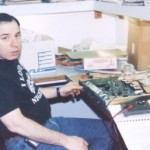
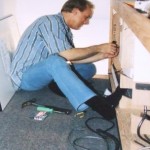
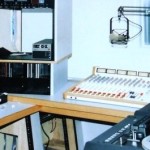
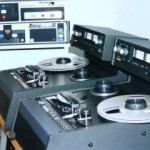
A few pictures:
More to come in Part IX…
Newport Tales – Part VII

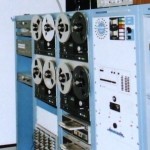
Our Schafer 903E automation system from the 1970s had been salvaged from KSKD when Keith and Jack left. Before Elite Broadcasting assumed this beast, Chris, our engineer, used it to heat his home in the winter. Once it was installed at KSND, the system ran off-air with old tapes so that I could practice operating the machine.

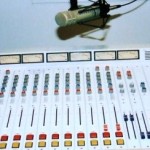
Next door to the automation room was our studio. Prior to recording all the programming elements for the Schafer, the studio had to be completed. Most of that work took place on weekends when Chris, who was the full-time engineer at KWJJ in Portland, could come down to Newport. While Chris and Keith worked on other equipment, Jack took on the monumental task of wiring the studio himself. I came over to the station to watch, help and eat lunch with the guys. Once everything was operational and our music service CDs arrived, it was time to record what we’d need for launch in March 1995.

The Schafer had four reel-to-reel decks. Two were for current music — A and B categories. One was for image gold songs — C category. The last deck was for regular gold songs — D category. Jack and Keith copyrighted a new format called “coastal contemporary.” It was adult contemporary, but the older songs had to fit a coastal mood. (Can you picture listening to this song while driving along the coastline?) Gold songs that passed the mood test and had superior audio production were Cs. The others were Ds.

C category songs at launch: Fleetwood Mac – Sara, Little River Band – Cool Change, Journey – Open Arms, Gloria Estefan – Traces, Brothers Johnson – Strawberry Letter 23, Loverboy – Turn Me Loose, and Alan Parsons Project – Sirius/Eye in the Sky. The latter was a perfect C song! We had somewhere between eight to 10 C reels with about 17 songs on each.

D category songs at launch: Huey Lewis and the News – The Heart of Rock ‘N’ Roll, Eagles – Take It Easy, Heart – Alone, Laura Branigan – Self Control, Cutting Crew – I Just Died in Your Arms Tonight, and Don Henley – The Heart of the Matter. There were around 16 to 18 D reels with about 17 songs on each.

We also had the A and B currents. The difference between the two was the number of plays each song on a particular reel received during a week. The A category held the hottest currents. Each song played 36 times per week. The B category rotated slower, with songs playing 24 times per week. There were two versions of each A and B reel, with songs recorded in different order on the second tapes.

A few currents we had at launch: Sophie B. Hawkins – As I Lay Me Down,  Linda Ronstadt – The Blue Train, Take That – Back for Good, Annie Lennox – No More I Love Yous, Eagles – Learn to Be Still, and Gloria Estefan – Turn the Beat Around.

We had a lot of work to do! Our library was recorded in real time around the clock for a week. I worked overnights during this process and loved cranking up the Bose studio monitors when no one was around.

Prior to recording the music, though, I had a final rookie test to pass. The Schafer automation system was able to give the current time — sort of. It had two time check tape decks. Every minute from 12:00 to 11:59 was verbally recorded. One tape deck held even times (12:00, 12:02, 12:04, etc.) while the other held odd times (12:01, 12:03, 12:05, etc.) The system automatically advanced each tape every other minute. I was given the task of recording one of them.

There was a BIG catch though. Every programming event — song, commercial or time check — had to have an inaudible tone recorded over the end. That tone triggered the next element to play on the air. The tone was recorded 1.50 seconds before the end of an event. The next element always had a 1.50 second dead roll before the audio began. This required perfection, otherwise the ending element played right over the starting event. There was a little leeway. Up to .02 seconds over or under still worked fine. Anything else and the element had to be re-recorded.

The problem with the time check was that it was recorded on a 30-minute cartridge tape that didn’t rewind. If a mistake was made, regardless of whether it was at the beginning or the end, the whole thing had to be re-recorded. It took about an hour to record 12 hours of time checks, so the last thing I wanted to do was restart in the middle. I had heard plenty of horror stories about that happening, either because a tone was off or the studio engineer had run out of tape before finishing. Good luck, rookie! Use the stopwatch!

Our station voice was the legendary Charlie Tuna. He recorded all the time checks onto reel at his home studio in Los Angeles and shipped them to Newport. I got busy re-recording them unto the cartridge tape one night. Charlie was a real pro. The sentence he read repeatedly was, “It’s (time) at K-S-N-D.” His cadence was consistent, and it was very easy to get the tone placement right — usually on the “at.” I got it right the first time through and finished with plenty of tape left over. The latter raised Jack’s suspicion the following morning. First of all, no one had ever gotten it right the first time. Second, there was way too much tape left. He figured I had recorded several tracks too close together. He double checked the whole tape, and was shocked that everything was solid. I’m still not sure he believed it. I was just glad to be done!

With staff hired, elements recorded, and testing completed we were very close to our launch date. We were pretty excited, but first there was some required reading from author Richard Bach.

A few pictures:

More to come in Part VIII…

Newport Tales – Part VI

Keith and Jack wanted broadcasters, not just radio people. They wanted an airstaff that understood the technical side of the business, as opposed to jocks who only knew how to crack jokes and start the next song. That is how, during my first several weeks, I ended up studying audio processing, recording techniques, and sound engineering in Keith’s old college textbook.

Meanwhile, Jack had me running around with a cork in my mouth with the belief that it improved one’s enunciation. His theory was that my enunciation would be perfected once I could speak clearly with the cork between my teeth. That would then translate on-air. It was an interesting idea but a skill I learned better, as it turned out, without the obstruction.

While an eager employee, it wasn’t long before I felt in over my head. One evening, in January 1995, I walked into Keith’s office, and we had a watershed moment in our relationship. I described feeling overwhelmed, and he told me how much it meant that I could speak to him about it. He wanted an open door policy with his employees, and so we talked.

It was at this point that he explained the broadcasters versus radio people philosophy he and Jack shared. The textbook was just to give me an overview. Regardless of how it sounded when I was handed the book, there weren’t going to be any tests. Keith also mentioned the cork-in-the-mouth task was something Jack made him do when he worked for Jack at Salem, Oregon’s KSKD during the early 1980s. I was told not to worry about any of it.

That conversation created a tremendous sense of relief. I was green but had some radio experience having worked in the industry part-time throughout college and after graduation. None of what I was experiencing now, though, had been covered at any of those other stations. KSND was uncharted territory a long way from home.

For the first several weeks, there wasn’t a lot to do other than read the textbook. When a radio station is off the air, it’s not of great value. I sat at the reception desk and greeted visitors. There were a couple a week. I answered the phone. It rang every couple hours. I also monitored the station that was to be our main competitor — logging their song playlist and commercials. I entered our music library into a spreadsheet and went along on field trips and client visits. And like any rookie, I took my turn cleaning the restroom.

When we had staff on board, I cross-trained with the CBSI (now Marketron) representative that taught Bonnie, our traffic director, how to use the software for scheduling commercials and producing program logs. Pressed into service once during that first year when Bonnie was gone for a couple days, I came to highly respect traffic people for the difficult job they do.

As winter began winding down and our spring launch date approached, I did fewer of these tasks as it was time to record the programming elements we needed. I had one more initiation test to pass…recording the dreaded time check.

More to come in Part VII…