
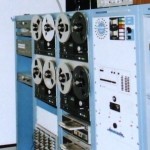
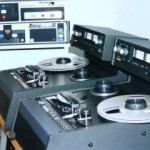
Our Schafer 903E automation system from the 1970s had been salvaged from KSKD when Keith and Jack left. Before Elite Broadcasting assumed this beast, Chris, our engineer, used it to heat his home in the winter. Once it was installed at KSND, the system ran off-air with old tapes so that I could practice operating the machine.
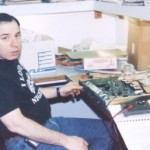
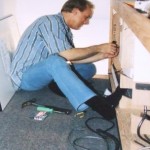
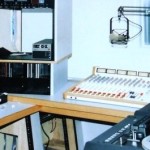
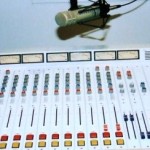
Next door to the automation room was our studio. Prior to recording all the programming elements for the Schafer, the studio had to be completed. Most of that work took place on weekends when Chris, who was the full-time engineer at KWJJ in Portland, could come down to Newport. While Chris and Keith worked on other equipment, Jack took on the monumental task of wiring the studio himself. I came over to the station to watch, help and eat lunch with the guys. Once everything was operational and our music service CDs arrived, it was time to record what we’d need for launch in March 1995.
The Schafer had four reel-to-reel decks. Two were for current music — A and B categories. One was for image gold songs — C category. The last deck was for regular gold songs — D category. Jack and Keith copyrighted a new format called “coastal contemporary.” It was adult contemporary, but the older songs had to fit a coastal mood. (Can you picture listening to this song while driving along the coastline?) Gold songs that passed the mood test and had superior audio production were Cs. The others were Ds.
C category songs at launch: Fleetwood Mac – Sara, Little River Band – Cool Change, Journey – Open Arms, Gloria Estefan – Traces, Brothers Johnson – Strawberry Letter 23, Loverboy – Turn Me Loose, and Alan Parsons Project – Sirius/Eye in the Sky. The latter was a perfect C song! We had somewhere between eight to 10 C reels with about 17 songs on each.
D category songs at launch: Huey Lewis and the News – The Heart of Rock ‘N’ Roll, Eagles – Take It Easy, Heart – Alone, Laura Branigan – Self Control, Cutting Crew – I Just Died in Your Arms Tonight, and Don Henley – The Heart of the Matter. There were around 16 to 18 D reels with about 17 songs on each.
We also had the A and B currents. The difference between the two was the number of plays each song on a particular reel received during a week. The A category held the hottest currents. Each song played 36 times per week. The B category rotated slower, with songs playing 24 times per week. There were two versions of each A and B reel, with songs recorded in different order on the second tapes.
A few currents we had at launch: Sophie B. Hawkins – As I Lay Me Down, Linda Ronstadt – The Blue Train, Take That – Back for Good, Annie Lennox – No More I Love Yous, Eagles – Learn to Be Still, and Gloria Estefan – Turn the Beat Around.
We had a lot of work to do! Our library was recorded in real time around the clock for a week. I worked overnights during this process and loved cranking up the Bose studio monitors when no one was around.
Prior to recording the music, though, I had a final rookie test to pass. The Schafer automation system was able to give the current time — sort of. It had two time check tape decks. Every minute from 12:00 to 11:59 was verbally recorded. One tape deck held even times (12:00, 12:02, 12:04, etc.) while the other held odd times (12:01, 12:03, 12:05, etc.) The system automatically advanced each tape every other minute. I was given the task of recording one of them.
There was a BIG catch though. Every programming event — song, commercial or time check — had to have an inaudible tone recorded over the end. That tone triggered the next element to play on the air. The tone was recorded 1.50 seconds before the end of an event. The next element always had a 1.50 second dead roll before the audio began. This required perfection, otherwise the ending element played right over the starting event. There was a little leeway. Up to .02 seconds over or under still worked fine. Anything else and the element had to be re-recorded.
The problem with the time check was that it was recorded on a 30-minute cartridge tape that didn’t rewind. If a mistake was made, regardless of whether it was at the beginning or the end, the whole thing had to be re-recorded. It took about an hour to record 12 hours of time checks, so the last thing I wanted to do was restart in the middle. I had heard plenty of horror stories about that happening, either because a tone was off or the studio engineer had run out of tape before finishing. Good luck, rookie! Use the stopwatch!
Our station voice was the legendary Charlie Tuna. He recorded all the time checks onto reel at his home studio in Los Angeles and shipped them to Newport. I got busy re-recording them unto the cartridge tape one night. Charlie was a real pro. The sentence he read repeatedly was, “It’s (time) at K-S-N-D.” His cadence was consistent, and it was very easy to get the tone placement right — usually on the “at.” I got it right the first time through and finished with plenty of tape left over. The latter raised Jack’s suspicion the following morning. First of all, no one had ever gotten it right the first time. Second, there was way too much tape left. He figured I had recorded several tracks too close together. He double checked the whole tape, and was shocked that everything was solid. I’m still not sure he believed it. I was just glad to be done!
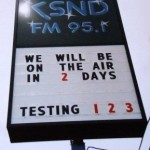
With staff hired, elements recorded, and testing completed we were very close to our launch date. We were pretty excited, but first there was some required reading from author Richard Bach.
A few pictures:
More to come in Part VIII…