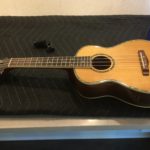
No songs today. Instead, the tale of earning my junior luthier badge. My Mitchell concert ukulele, which I started on and still play, sounded recently like an injured dairy cow. The strings were tuned, but they weren’t staying in tune while playing. (No, it wasn’t my playing!) The intonation was affected by both the age of the strings and the indentations that formed from being pressed against the frets.
I’d been dreading this day because it meant either taking the uke into the shop and paying someone around $30 to restring it for me or trying to do it myself with the possibility of suboptimal results. My Islander tenor ukulele, after a year, needed to have its strings replaced too. They sounded okay, but it’s recommended that strings be changed at least once a year. So, that meant parting with $60 and being without each instrument for a week at a time. I practice every day, so this was problematic, and I’d rather save the money, thanks. Also in the back of my mind was what an inconvenience it would be to snap a string while playing and then have to wait until a day off to get the uke into the shop. More lost time. Ugh.
Then I came across an online video that was better than any other how-to I’d found on string changes, covering the different bridge and headstock types. I decided to be bold and learn a useful skill. I spent about $50 to get a few tools: a quality string winder, nut and bridge lube, a neck support cradle, a wire cutter, and a bridge pin puller. I used Music Nomad products, which are great. I bought my strings through Strings By Mail, which came recommended on ukulele sites. They’re much cheaper to purchase that way, and the customer service is spectacular — handwritten thank yous and an assigned customer service representative — for strings. Strings!
I have come to like Aquila Super Nylgut strings, which were stock on my Islander and better quality than what was on my Mitchell. They are supposed to settle into tune quicker than other string sets.
I opted to change the strings on the Mitchell first for a couple reasons. One, the current strings were unplayable, and two, since I don’t play it as much as the Islander, I wouldn’t lose time on my primary instrument should I have mishaps. I took a few pictures of the surgical procedure:
The process was not without its struggles. Standard tuning for the ukulele is G-C-E-A. Traditionally the ukulele uses reentrant tuning, which means the strings don’t ascend in order. The G is high and the C is lower — the equivalent of middle C on the piano. The E and the A are higher than the C. So, the thickest strings are the C and E. The thinnest are the G and the A. Why am I mentioning this? Because I messed up the size of the knots I made that slide under the bridge and help keep the strings in place.
I put the G string on first, sliding it under the bridge and then winding the other end around the tuning peg on the headstock. Everything went well…until the string came flying out from under the bridge. Could have put an eye out! The how-to video suggested tying a double knot and slipping it under the bridge, but that didn’t work. So, I added a third knot, and that solved the problem. Yay! I put the C string on next, using my newfound knowledge. This didn’t work because the gauge of the string is much thicker than the G string. One knot would have been fine, but three made it impossible to slip under the bridge. I had already cut off the excess and I couldn’t undo the knot. I finally gave up and snipped the knot off and restarted. Unfortunately there was little excess string to begin with, and the ideal is to have three to four neat loops around the tuning peg. I only have two! It should hold fine, but that was cutting it close. The last two strings went on without a hitch.
The strings need to be broken in, which only happens with playing. Right now they’re going out of tune in the middle of a song, but it should only take a few days until they settle in. Already when in tune, the ukulele sounds better than it did with the old set of strings.
It took me around an hour to perform this surgery, so Jake Shimabukuro and Taimane won’t be calling me anytime soon to be the ukulele tech on their road crews. But hey, there were no injuries, nothing got damaged and the swearing was kept to a minimum. I’ll call it a success that gives me confidence to change the strings on my nicer Islander.
This was a real journey into the weeds on how to keep an instrument in good shape, but it’s all part of the experience on this ukulele journey I’ve been on for a year now. In my next installment I’ll tackle a tropical song — with strings that sound great.